
This guide audits the information visible before ordering. It does not certify authenticity, predict warehouse condition, or recommend a specific product.
Confirm that the card and destination describe the same shoe
A shoes index is useful only when its card leads to a detail page for the same product. Open the destination and compare the product family, silhouette, colour treatment and seller-page title with the card you clicked. Do not assume a similar hero image is enough: sellers can reuse photographs across different batches, materials, colourways or option structures.
Check the final URL after any redirect. A product link may still load while landing on a generic category, an unavailable-item notice, a search page or a replacement listing. Record the seller or shop name and the visible listing identifier when available. If the destination no longer identifies the shoe, treat the row as stale rather than trying to reconstruct the intended product from the image.
This first check prevents the most basic failure: carefully reviewing size and price on a page that does not represent the indexed item. A valid click should preserve enough identity to compare the card, option selector and current offer without guesswork.
Read the option selector before reading the headline price
Marketplace shoe pages often combine several colours, versions, accessories or payment types under one listing. The headline price may reflect the least expensive selectable entry rather than the shoe in the first photograph. Open every relevant selector and match the option text with its image and price.
Look specifically for entries that represent a deposit, balance payment, replacement part, accessory or after-sales add-on. Do not treat those as a discounted full pair. Confirm that the quantity is one pair and that both shoes are included; a seller image showing a pair is not a contractual quantity field.
Save the selected option text exactly as displayed. If automatic translation is unclear, keep a screenshot beside a short note describing the chosen image. A clean record lets the purchasing agent execute a precise choice and gives you something concrete to compare when the warehouse record appears.
Use measurements, not a familiar size label
A printed EU, US, UK or centimetre size is only a label until the seller explains how it maps to the product. Look for a size chart tied to the current listing and identify whether it describes foot length, insole length, outsole length or a general recommended size. Those measurements are not interchangeable.
Measure a shoe that already fits, using the same measurement type stated by the seller. If the chart gives insole length, compare insole with insole. If it gives foot length, measure the foot as instructed. Leave room for sock thickness and the intended fit, but do not invent a universal conversion between brands or models.
Pause when the listing has only a size label and fit is critical. A warehouse size-tag photograph can later confirm the label received, but it cannot prove the shoe will fit. The strongest pre-order evidence combines the seller chart, a comparable shoe and a clearly selected variant.
Audit the images for one consistent product
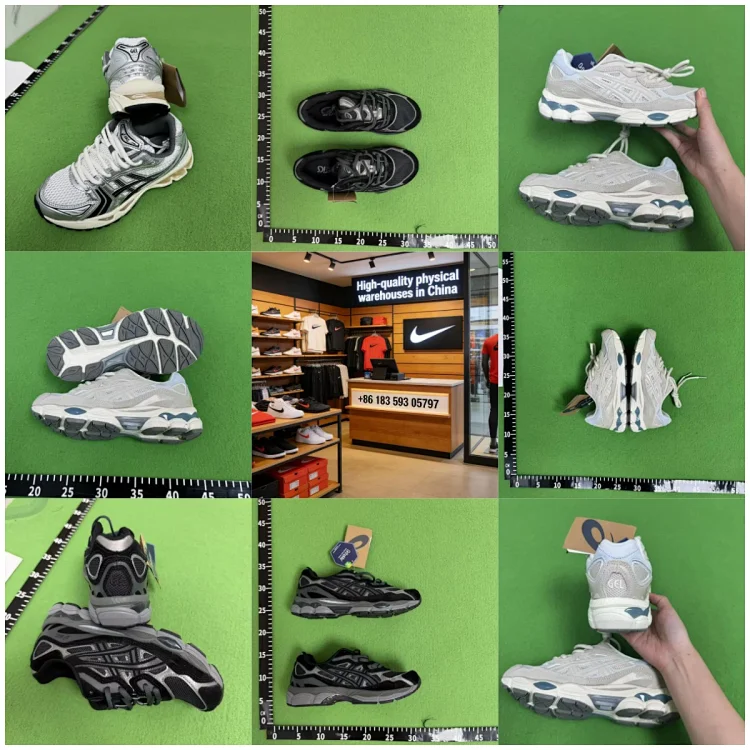
Move beyond the first image. Compare lateral and medial sides, heel, toe, tongue, outsole, insole, fastening and packaging where shown. Check whether logos, panel lines, sole shape and material texture remain consistent across the gallery. Sudden changes may mean the listing mixes colourways, batches or reference photographs.
Treat lifestyle images as context, not specification. Lighting can change colour and wide-angle lenses can distort shape. Look for neutral product views and detail photographs connected to the selectable option. If only one angle exists, record that limitation instead of filling it with assumptions.
The goal is not to perform warehouse QC before the item exists. It is to decide whether the seller page defines a product clearly enough to order. Visible consistency is evidence; silence about material, internal construction or long-term wear is still silence.
Separate seller claims from verifiable fields
Place each important statement into one of three columns: selected field, seller claim or unknown. Size option, quantity and displayed price are selected fields. Statements about leather, cushioning, version or quality are seller claims unless supported by a useful specification. Authenticity, durability and exact comfort usually remain unknown before independent evidence.
Do not convert promotional wording into an editorial conclusion. A phrase such as “top version” does not identify a batch or measurable construction standard. If version matters, look for a seller-defined code, material list or comparison that distinguishes it from other options on the same page.
This classification makes the later decision clearer. You can order with some unknowns when their risk is acceptable, but you should not describe an unknown as verified merely because it appears in a translated title.
Check seller and transaction signals
Review the seller information visible on the marketplace page: shop identity, how long the listing appears to have existed, available sales or feedback context, dispatch information and after-sales wording. Not every marketplace exposes the same fields, and no single score proves the next pair will be correct.
Prefer a coherent pattern over one impressive number. A seller page with stable product details, clear variants, usable size information and defined after-sales terms gives you more to verify than a page with only promotional photographs. If recent feedback includes useful size or option references, treat it as attributed user reporting, not a guarantee.
Record domestic delivery and any quantity rule before checkout. Seller-to-warehouse cost and dispatch are part of the listing decision, even though international shipping is a later stage.
Estimate the shoe-specific parcel trade-off
Shoes are a product-discovery decision with a packaging consequence. A retail box can preserve shape and presentation but adds weight and volume. Removing it may reduce volume but can increase crushing risk if replacement protection is weak. Do not promise savings before the packed dimensions and route rules are known.
Before ordering, compare two plausible scenarios: pair with box and pair without retail box but with protective packing. If the shoe is rigid, delicate or intended as a gift, protection may outweigh the cheapest theoretical parcel. If the box has no value and the shoe tolerates compact packing, the volume trade-off may point the other way.
This is not a shipping-cost article; it is a go/no-go check. If the purchase only looks sensible under an unrealistic zero-volume packaging assumption, the listing is a poor shortlist candidate regardless of its product price.
Score the listing and decide
Give one point for each resolved field: correct destination, seller identity, full-pair option, colour, model or version, quantity, useful size evidence, coherent images, domestic delivery and acceptable packaging scenario. Mark any field that depends only on a claim.
An unresolved cosmetic detail may be acceptable. An unresolved identity, quantity, payment type or size field is more serious because warehouse photos may arrive after you have already paid the seller. Use a stop rule: do not order when one missing field could turn the purchase into a different product, wrong size or partial payment.
Save the final audit with the date, link, option screenshot and decision. Recheck the live page immediately before payment. A good USFans shoes listing is not the one with the boldest thumbnail; it is the one whose identity, option, size evidence and risks remain understandable after every field is opened.
Compare the right kind of length
Foot length, insole length and outsole length describe different things. A chart labelled foot length should be compared with a foot measurement, while an insole photograph should be compared with a suitable reference insole measured in the same way. Treating all three as one universal shoe length can create an avoidable size error.
Use the seller measurement instructions when provided and account for the intended socks and use. Width, toe shape and construction can affect fit even when length appears suitable. Do not add a universal allowance and promise a guaranteed result. If the listing does not define its chart, resolve that uncertainty before choosing a size; the label alone cannot supply the missing definition.