
This is an independent product-research guide. Measurements and examples explain a checking method; they are not seller guarantees, product tests or live shipping quotations. Confirm the selected listing, option and current service terms before payment.
Choose the jacket category before comparing
A jacket shortlist becomes useful when it reflects the conditions in which the garment will be worn. Decide whether you want a light shell, a lined casual jacket, a denim layer or a padded outer garment. Record the intended layers, desired length, hood preference and pocket requirements. Similar front photographs can conceal very different construction and fit.
Describe your requirements without turning them into performance claims. A shell-like appearance does not prove waterproofing, and visible padding does not establish a temperature rating. If performance matters, look for specific manufacturer or seller evidence for the exact product. Leave unsupported properties unknown rather than borrowing claims from a familiar brand or a different model.
Verify the complete product and version
Open the current product destination and compare its title, main image and selected options with the collection card. Confirm whether the listing describes a jacket, a vest, a removable liner or another component. Multi-version pages can mix these items, so an appealing headline price may not refer to the complete garment you intend to buy.
Save the selected colour, size and version along with the current listing date. Note removable hoods, liners, belts or other pieces only when the chosen option includes them. A gallery photograph can show accessories used for styling. It is not enough to assume that everything visible in an image will arrive with the selected item.
Measure a comparable jacket with layers in mind
Use a jacket that fits comfortably over the clothing you expect to wear. Compare chest width, shoulder width, body length and sleeve length using the same points as the seller's chart. A close-fitting T-shirt is not a direct substitute for an outerwear reference. Fabric thickness and intended layers affect the space needed inside the garment.
For an illustrative comparison, suppose your comfortable jacket measures 60 cm across the chest and 72 cm in length. A candidate listed at 58 cm and 76 cm is narrower and longer under an equivalent method. Do not interpret its larger letter size as proof of extra room. Compare each dimension and decide whether the difference suits the intended layers.
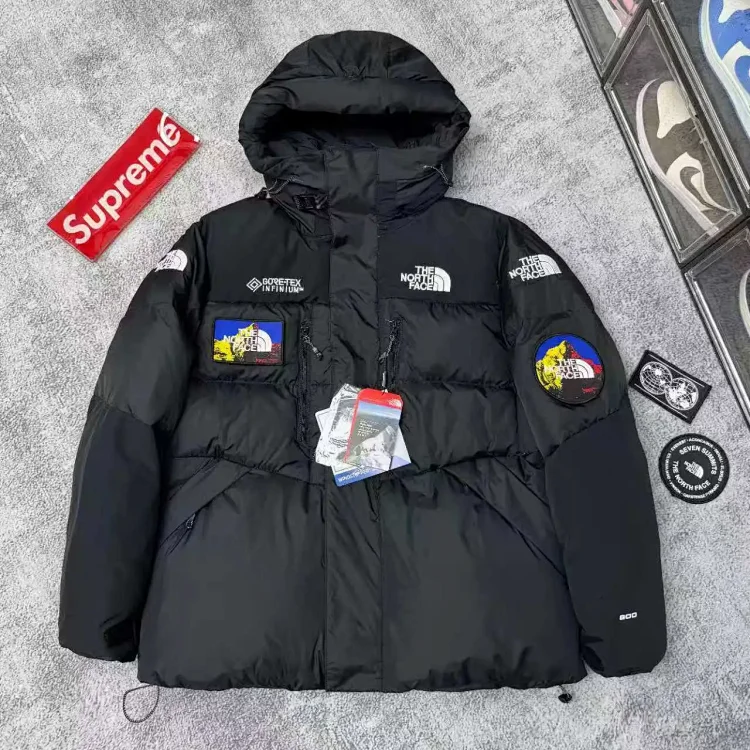
Check shoulder and sleeve construction
A standard shoulder seam, a dropped shoulder and a raglan sleeve require different interpretation. A long sleeve measured from the neck includes a distance that a shoulder-to-cuff measurement excludes. Look for a diagram and identify the starting point. If the methods differ, request a comparable measurement rather than subtracting an arbitrary number.
Check cuff shape, adjustment tabs and the way the sleeve meets the body. These details affect practical fit even when the headline measurements look similar. Photographs of a model can help explain the silhouette, but the model's pose and styling cannot confirm how the jacket will move on you. Keep the size decision grounded in measurements and construction.
Read materials and insulation carefully
Separate outer fabric, lining and filling when the listing provides those fields. A general description such as padded says little about the exact filling. A photograph cannot verify composition percentages, insulation performance or the consistency of fill. If the listing names a material, record it as a seller claim until there is stronger evidence.
Avoid universal warmth rankings based on weight alone. Total garment weight includes shell fabric, lining, hardware and other components. It is not a direct measure of thermal performance. Likewise, a shiny or tightly woven surface does not by itself establish resistance to rain. Specific performance requirements need evidence for the selected item, not a confident guess from its appearance.
Inspect closures, pockets and removable parts
Review the front closure, zipper alignment, pocket openings, stitching, hood attachment and hem adjustments. Identify which pockets appear functional and which details are decorative. For a jacket with a removable liner or hood, confirm the fastening system and that the selected option includes the relevant parts. Save the seller's detail images for later comparison.
At warehouse stage, request a photograph of any important area that is hidden in the standard views. A closed front image cannot confirm every interior detail. Visible zipper damage or missing hardware should be documented precisely. A photograph of an intact zipper also does not prove long-term reliability, so keep the conclusion limited to what the evidence actually shows.
Review warehouse measurements before shipping
Check product identity and the selected version first, then compare labels and measurements. Ask for the garment to be measured in a way that matches the saved chart where that service is available. Distinguish a measurement taken over bulky fabric from one taken with the garment laid naturally flat. Do not stretch the item to make a number match.
If a critical dimension differs, record the expected and observed measurement and the method used for each. Resolve the discrepancy with the seller or agent within the current service window. Keep the jacket out of parcel submission while a material issue remains open. International transport adds cost and can make a simple warehouse correction substantially less practical.
Plan packing using actual parcel dimensions
Outerwear can occupy more space than its weight suggests. Compare route quotations using the final packed dimensions as well as the actual weight. A carrier may use a volumetric formula, minimum charge or rounding rule. Read the rule for the selected route instead of assuming that every shipping line uses the same divisor.
Consider an illustrative package measuring 40 by 30 by 20 cm and weighing 3 kg. Its volume is 24000 cubic centimetres. If a route uses a divisor of 6000, the calculated volumetric weight is 4 kg. This is an arithmetic example, not a USFans rate or a statement that the route will charge exactly 4 kg after its other rules.
Compare compression and protection decisions
Reducing unused packaging can change parcel volume, but aggressive compression is not suitable for every item. Consider rigid trims, structured panels, attached hardware and any care instructions before requesting vacuum packing. Ask what a packing service actually does. Do not assume that every padded garment can recover from any compression method without consequences.
Compare the quotation for reasonable packing with an alternative that keeps more protection. Include any service charge in that comparison. A smaller box is not automatically a better choice when it exposes a zipper, trim or structured part to damage. Record what packaging you asked to remove and what protection should remain so the instruction can be checked later.
Keep a decision record for the final shortlist
For each jacket, save the link, chosen version, garment measurements, intended layers, materials as described, visible construction, included parts and current price. Add a separate list of unknowns. The result should explain whether the candidate satisfies your requirements, rather than assigning an unsupported quality score from attractive photography.
Use the jacket category to find candidates, the clothing guide to compare measurements and the shipping guide to plan the final parcel. Recheck the listing immediately before ordering and preserve the warehouse record until delivery. Your next comparison will be stronger if you document the actual fit and any mismatch, while remembering that another option or later batch may differ.
Keep examples separate from current listing facts
The numbers in this guide are illustrative comparisons, not measurements of every product in the collection. A live listing must supply its own option details and size information. When a value is absent, record it as unknown. Do not transfer a sample measurement, material claim or packing assumption into a product description without evidence for that specific item.
Use the current destination as the reference for availability and selected price, then confirm the actual unit in warehouse photos. Product names and images help identify a candidate; they do not certify authenticity, materials or long-term performance. Keep your conclusion limited to the evidence you have, and update the comparison whenever the listing or chosen option changes.